
Incontinence Direct
Private, Non-Surgical Care
Discreet Support for Sensitive Health Concerns
Incontinence Direct provides a non-surgical option for men and women seeking support with sensitive bladder, bowel, pelvic floor and related health issues. Care that feels restful, private, and pragmatic.

For many people, incontinence is more than a physical symptom. It quietly takes up space in everyday life. It can shift the mindset around exercise, sleep, intimacy, outings, work meetings and travel. It can create a low-level sense of frustration and embarrassment that is genuinely difficult to express to others.
The workarounds become second nature. People plan around toilets. They carry extra clothing. They avoid certain activities or outings altogether. In public they may laugh it off, but behind closed doors the constant management is exhausting.
Which is precisely why this service exists. It provides people with somewhere to begin. A setting in which the problem is viewed as both genuine and common — one that warrants real consideration and thoughtful, practical care.
The last thing someone dealing with incontinence needs is to feel judged. They need a service that appreciates how personal this can be. They require a space where the conversation is handled with respect, the enquiries are embraced as real and genuine, and any next step sounds attainable rather than insurmountable.
Incontinence Direct is a specialist provider of non-surgical treatment for men and women, promoting privacy, confidence and quality of life. Access to care is described as home-based where needed, allowing clients to receive support in the comfort of their own environment.
Many people already know they deserve help. What holds them back is whether the process will feel overly clinical, awkward, or unnecessarily exposing. Which is precisely why tone of care matters so much. From the very first moment, this service should feel calm and unrushed.
Whether symptoms are mild or long-standing, whether someone has been struggling quietly for months or for years, they deserve to have the seriousness of their situation taken seriously. Incontinence support should never feel hurried. It should feel thoughtful. It should begin with listening.
Consultations, treatments and home visits are conducted privately. No need to undress — treatment involves simply sitting on an EMS device. A peaceful, low-pressure experience that honours the body at every step.
Treatment is designed to fit around normal life. Sessions are quick, non-invasive and require no recovery time. People can return to their regular activities immediately after each session.
Incontinence does not belong to one gender, one generation or one type of person. This service is designed for both men and women, across a wide range of related symptoms and concerns.
Most people put off seeking help because they think the problem will resolve itself. At times the experience is minimised. At other times people simply get used to making adjustments. They plan around toilets. They carry extra clothing. They avoid certain activities. In public they may laugh it off, but behind closed doors they can be utterly fatigued by the management of it all.
Incontinence can quietly occupy an enormous amount of room in everyday life. It turns simple things into harder things. It can affect how someone feels about exercise, sleep, intimacy, social outings, work meetings and travel. It can also create a low-level sense of frustration and embarrassment that is genuinely difficult to express to others.
Incontinence Direct addresses a range of related issues, including urgent leakage, stress urinary incontinence, overactive bladder, faecal concerns, pelvic floor weakness and related matters. The service presents treatment as ideal for self-conscious adults seeking non-invasive and discreet assistance.
The service is not about making the situation feel more dramatic than it already is. It is about giving the problem the serious, steady attention it deserves. Not a dramatic first step. Just a steady one. A conversation. A consultation. A treatment plan. An opportunity to start again without shame.
People move forward more safely when their sense of security is assured. When they feel genuinely understood, they are far more likely to trust the process. And when they trust the process, they are more likely to stay with it long enough for something meaningful to change.
It is a non-invasive service that plays an important role — providing people with somewhere to begin. A setting in which the problem is viewed as both genuine and common, thereby warranting serious consideration.
Not everyone wants surgery. Others do not need a lengthy recovery. Some people simply cannot afford to pause their lives while they wait to see what happens next. This is where a practical, non-surgical approach becomes the approach that actually works for most people.
Electromagnetic seating treatment — EMS treatment — is the focus of this service. It is a non-invasive therapy designed to strengthen pelvic floor muscles and alleviate symptoms without surgery or downtime. The treatment is painless, does not involve undressing, and can be carried out without any recovery period.
Comfort makes a genuine difference. People are more likely to engage with treatment when it feels straightforward. When privacy is respected, people act with more ease. Ensuring the process never disrupts someone's day makes it far easier to continue after the initial sessions are completed.
The treatment is entirely non-surgical. There are no incisions, no needles, no medication and no procedures requiring recovery time. It is a modern, comfortable alternative that does not demand significant change.
Patients remain fully clothed throughout every session. There is no need for physical exposure of any kind. This is one of the most important features of the service — keeping the experience genuinely comfortable and entirely dignified.
Treatment can take place at home for those who prefer it. Home-based care removes the most common barriers — anxiety, scheduling, mobility and the need to be seen in a clinical environment by others.

Privacy is not a small feature of this service. It is one of the primary reasons many people choose to seek help at all. They want reassurance that the conversation will remain private. They want to know they will not be placed in an embarrassing situation. They want reassurance that the treatment itself will be quiet and low-key.
Consultations, treatments and home visits are private with no chance of being observed. For the treatment itself, no disrobing is needed — patients simply sit on the EMS device. This is presented as a peaceful, low-pressure experience that honours the body at every step.
That is the kind of reassurance this service should place front and centre. It should be crystal clear that this is personal care done personally. Nobody should feel embarrassed or rushed at any point in the process.
Incontinence is an intimate subject and the care surrounding it should reflect that deeply. A good service does not simply state that it is discreet. Privacy is a core part of the entire experience — not a feature added on at the end, but a value that runs through every interaction from start to finish.
Another reason people postpone support is simple practicality. Life is busy. Work is busy. Family life is busy. Attending appointments can become an additional burden, particularly when someone already feels anxious or is managing discomfort.
Incontinence Direct features national clinics and also provides options for home-based treatments, offering real convenience. Appointments are described as quick and can begin in ways that feel less daunting — allowing people to start the process on their own terms.
Being seen in a professional clinic environment is the right choice for many people. The clinical environment offers structure, reassurance and the comfort of knowing a specialist is present throughout each session. National clinic access means people are rarely far from appropriate support.
Home-based care can be invaluable for people who feel anxious about attending a consultation in person, who struggle with mobility, who have very busy schedules or who simply prefer the security of their own private space. For others, it removes the single biggest obstacle entirely.
The flexibility of this combination is important. It normalises and legitimises both choices equally. There is no one right way to start. That flexibility is itself a form of kindness — one that says the service is built around the individual, not the other way around.
Incontinence does not belong to one gender, one generation or one kind of person. There is no single experience, and no single background. Men and women may experience different patterns of symptoms, different causes and different emotional responses. Some adults notice urinary leakage. Others experience urgency, mixed symptoms or bowel control concerns. Some are dealing with pelvic floor weakness or related intimate health matters.
This treatment is designed for both men and women. It addresses urinary incontinence, stress incontinence, mixed incontinence, overactive bladder, stool incontinence and erectile dysfunction — each of them real, recognised and treatable in a non-surgical way.
Leakage during physical activity, sneezing, coughing or exercise. Or the urgent need to reach a bathroom that is difficult to suppress. Both types are addressed with the same calm, non-surgical approach.
The constant urgency, interrupted sleep, the anxiety about knowing where the nearest toilet is. An overactive bladder should not dictate the schedule — and with the right support, it does not have to.
Stool incontinence is among the most intimate and difficult issues a person can carry. The service addresses it directly, quietly and without judgement — offering a non-surgical path toward improved control.
Pelvic floor strength underpins many of these symptoms. EMS treatment focuses on rebuilding that foundation — addressing the source rather than simply managing the surface symptoms.
Men living with erectile dysfunction often carry the emotional burden quietly. A non-invasive, fully-clothed treatment approach means the path toward improved function can begin discreetly and without disruption.
Post-childbirth changes, symptoms following prostate surgery, age-related weakening and mixed symptomatic presentations are all areas the service is designed to support.
The relief that many people experience when they realise their problem is understood within a wide-ranging, considered framework is significant. They do not require a service that addresses only one narrow type of symptom. They require one that appreciates the full picture — and responds accordingly.

A great many people do not begin a course of treatment because they fear it will require days off work, physical discomfort or significant recovery time. That concern alone — that treatment will add more disruption to an already disrupted life — can be enough to keep someone in place for far longer than is necessary.
The messaging here is clear on this point. Treatment is non-invasive, quick and allows people to return to regular activity immediately. It is pitched as a low-maintenance solution that does not require an upheaval of the weekly schedule.
This is an important message, because it addresses one of the most immediate and practical concerns people have. They are not looking for more change. They are looking for care that allows them to keep up with their lives — and not flip their entire week over in order to pursue it.
The tone around this should always be grounded. No need to overstate the experience or make claims that feel too large. People want something defensible, understandable and accessible. They want assurance that the plan is designed to fit alongside their life, not to suffocate it.
Treatment is designed around the individual. It is non-surgical, discreet, and shaped to fit around real life — not the other way around. That is the whole point.
Reading about the treatment should produce a sense of quiet relief. It should feel like a service that respects time, comfort and privacy with equal seriousness. A course of care that truly earns its place in someone's week.
No treatment works unless it begins with the right dialogue. The consultation stage is crucial — it is where a person can explain their situation in their own words, ask questions in their own time, and begin to understand what a service might genuinely look like for them specifically.
Online consultations are available, and people can book a private consultation directly without requiring a referral. The consultation gives individuals time with a professional who can build a treatment plan around their particular symptoms, goals and comfort level.
That matters, because no two people arrive with the same story. One person may have first noticed symptoms only a few weeks ago. Another may have been managing them quietly for years. One person may simply want reassurance. Another may be ready to commit to a more structured plan. The consultation must be capable of meeting all of those people where they are.
Begin by making an initial enquiry in a way that feels manageable. No referral is needed. No lengthy forms or clinical procedures. Simply the beginning of a private conversation.
Speak with a specialist about symptoms, concerns and goals. This is a calm, professional conversation — not an assessment or examination. A chance to be heard properly.
Receive a treatment plan built around individual needs. No generic protocols. A thoughtful plan that reflects the specific symptoms, lifestyle and preferences of the person.
Sessions begin at home or in a clinic — wherever is most comfortable. Each session is quick, painless and requires no recovery time. Life continues as normal throughout the course.
A good consultation should feel like a natural initial dialogue. Not formal. Not intimidating. Just a chance to speak openly, to be genuinely heard, and to learn clearly how support might take shape. That ease of beginning makes all the difference for the people who have been holding something quietly for a long time.
While shame is not a necessary part of incontinence, the two are frequently connected. People feel uncertain about how to raise the subject. They worry about how they will sound. They fear being judged, or dismissed, or told their concern is too minor to matter.
Confidence does not come from ignoring the problem. It comes from being able to talk about it without fear. And that is the deeper purpose of a service like this — providing a safe space where the vicious cycle of silence can be gently and respectfully broken.
This service was designed to restore confidence and improve quality of life. It addresses abdominal muscle function, bowel and bladder control, pelvic floor concerns and sexual health conditions — all of them legitimate, all of them manageable, and all of them worthy of genuine attention.
The emotional outcome matters just as much as the clinical one. Not in a dramatic way, but in a deeply human one. Every person who seeks support wants to feel more like themselves again. They want to leave the house without constant worry. They want to enjoy time with family and friends, return to exercise, travel without anxiety, and move through the day without the weight of a problem they have been carrying alone.
This service does not promise a miracle. It offers care that takes the problem seriously and treats the individual with respect. That combination — honesty, privacy and genuine support — is often exactly what someone needs.

When a subject is sensitive, clarity is kindness. That is especially true in healthcare. People do not need clever language or technical complexity. They need language that is sensible. They need to understand clearly what the service is, who it serves and why it might help.
The service is already built around this idea. It uses simple, direct claims: non-surgical treatment, private care, home-based convenience, no downtime and support designed for both men and women. The treatment is described as painless and non-invasive. There is no jargon to decode.
That is a solid foundation — because it stays close to what actually matters. It does not require the reader to wade through medical terminology. It allows someone to understand the value quickly and then decide whether they want to take the next step.
A page written this way should read like a gentle, unhurried conversation. It should not rush the reader. It should not dramatise the situation. It should not maximise the problem or make unrealistic promises. It should simply face the reality honestly and offer something realistic in return.
That is often exactly what somebody needs when they have been holding something quietly for a long time. They do not need drama. They need clarity, warmth and a direction. They need a gentle but honest reminder that support exists — and that it can be accessed privately, practically and on their own terms.
Great healthcare writing does a few simple things well. It makes people feel genuinely seen. It reduces fear. It offers a direction forward. And it is a steady, quiet reminder that support can be soft and structured at the same time.
This is what the entire experience — from the first line of copy to the final session of treatment — should embody. Every word counts. Every moment of reassurance counts. Every step that feels manageable counts. That is how trust is built, and that is how lives are quietly, meaningfully improved.
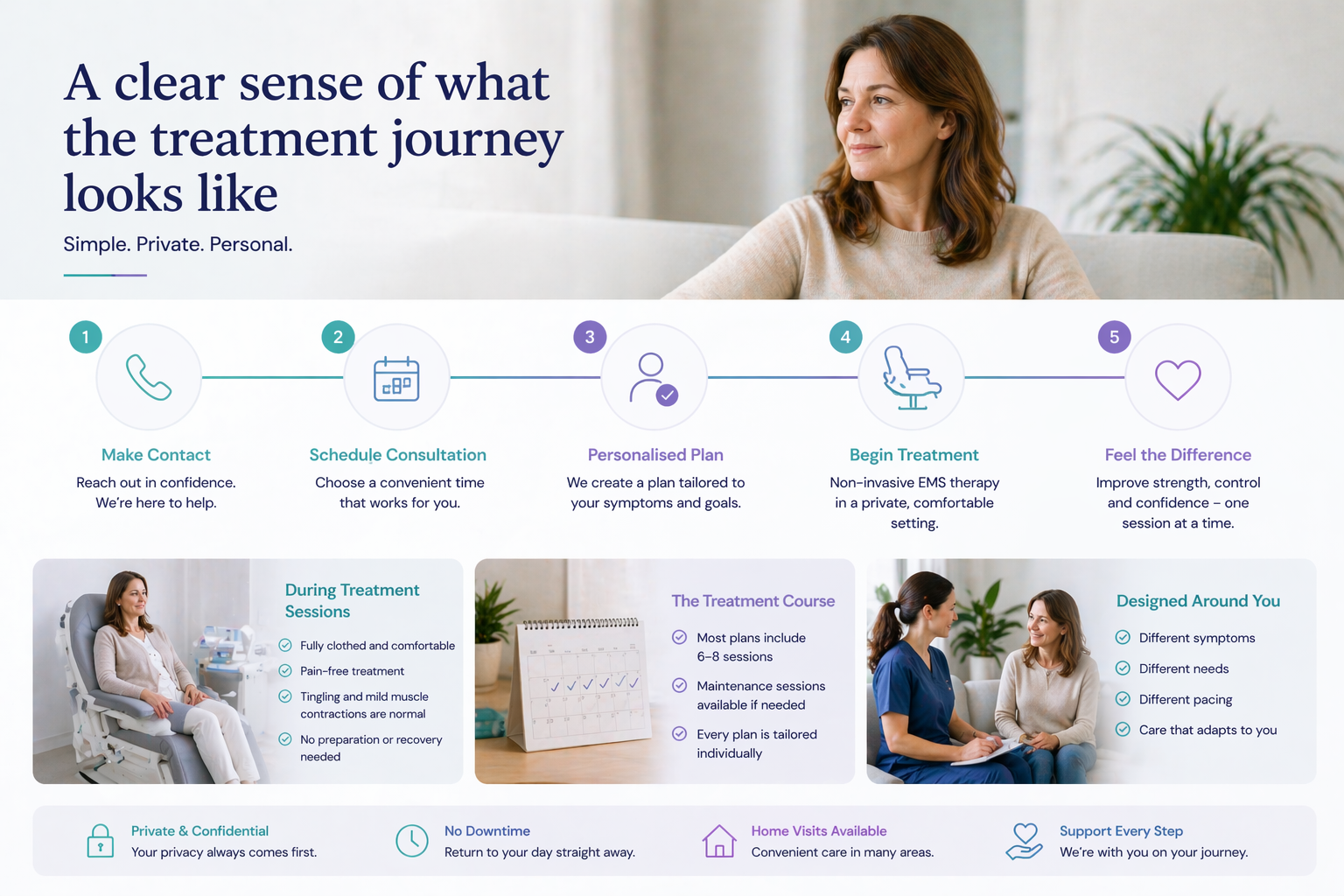
Expectations are one of the most comforting things a service can offer. A short, clear outline can reduce anxiety considerably. People hesitate when a service seems mysterious or unclear. When the path ahead is described plainly, they settle more easily into the process.
The roadmap is straightforward. A person makes contact, schedules a consultation, receives a personalised plan, and then begins a course of treatment that is private, non-invasive and requires no major disruption to daily routine. Quick appointments and home visits in many areas make the process even more accessible.
Patients remain fully clothed and sit comfortably throughout each EMS session. The treatment itself is pain-free. Most people notice sensations of tingling and mild muscle contractions in the pelvic floor area — a sign that the technology is working. There is nothing alarming, nothing unexpected and nothing that requires any form of preparation or recovery.
The majority of people are able to return to their normal daily routine immediately after each session. There is no soreness, no downtime and no side effects that disrupt the rest of the day.
Most plans recommend approximately six to eight sessions. Some people opt for maintenance sessions following their initial course to sustain the benefits over time. Every plan is tailored individually — different symptoms require different responses, and different people benefit from different pacing.
That sense of structure is important. People want to know the treatment is real. They also need to feel that it is entirely manageable. The clearer the path ahead, the easier it is to take that first step — and then, one session at a time, to continue.
Custom care is not a luxury in this context. It is the entire point. Different symptoms need different responses. Different people need different pacing. A good treatment plan reflects that reality from the very beginning.
Some people seek support promptly after symptoms first appear. Many others wait far longer. They may have been managing quietly for months, or for years. They may be genuinely exhausted by the effort of managing everything privately. They may be well aware of how much time has passed while the problem has quietly taken up more and more room in their daily life.
This service approaches those people with particular gentleness. It makes clear that it is never too late to seek support. And it is equally clear that the service is here for people at different stages — with different levels of confidence, different types of symptoms, and different ideas of what they are ready for.
People can seek help with no referral needed. They can book directly and receive a personalised recommendation based on their own specific circumstances. That flexibility is crucial — because it reduces the barrier to entry considerably. A person does not need to know everything in advance before reaching out. They simply need the willingness to begin a conversation.
Most people think they need to feel certain before they take any action. In reality, all they truly need is a safe place to begin. A calm, competent, non-judgemental starting point. Something that says: the problem is understood, the support is here, and it is available in a way that works for real life.
Quiet care has a particular kind of dignity. It does not need to announce itself. It simply needs to be reliable, private and genuine. And that kind of steadiness is exactly what people dealing with incontinence are looking for — particularly those who have spent a long time managing quietly by themselves.
The service is described as discreet, pain-free and comfortable. It is for those who want assistance without undue burden — without surgery and without major disruption. It is presented as something built for adults dealing with issues that are, most of the time, genuinely hard to talk about.
That makes this less about selling a treatment and more about offering relief. Relief from uncertainty. Relief from shame. Relief from the silent weight around a problem that has been carried alone for far too long.
Most healthcare encounters carry a necessary sense of clinical formality. This one should not. It should feel like at least one person genuinely understood the problem — and made the path toward a solution feel less daunting, less clinical, and far more human.
That difference matters enormously. The service already does a good job of establishing this foundation — through its emphasis on comfort, discretion, home accessibility, non-invasive treatment and minimal downtime. It is also clear that it serves both genders, across a wide range of related symptoms.
This is not about fitting a person to a treatment. It is about moulding care around the individual. A simple idea — but one that makes all the difference between a service that feels clinical and one that genuinely helps.
Taking the first step can feel daunting for someone who has been managing symptoms for so long that they have almost become part of daily life. The worry might have become as routine as anything else. The workarounds might have become second nature. The quiet shame might have become its own private habit. Help — even practical, physical help — can still feel surprisingly hard to reach for.
But often, that first step is much smaller than people anticipate. A private conversation. A quick consultation. A non-surgical, no-downtime treatment option. An arrangement that honours comfort and dignity at every point. A way to begin without upending everything.
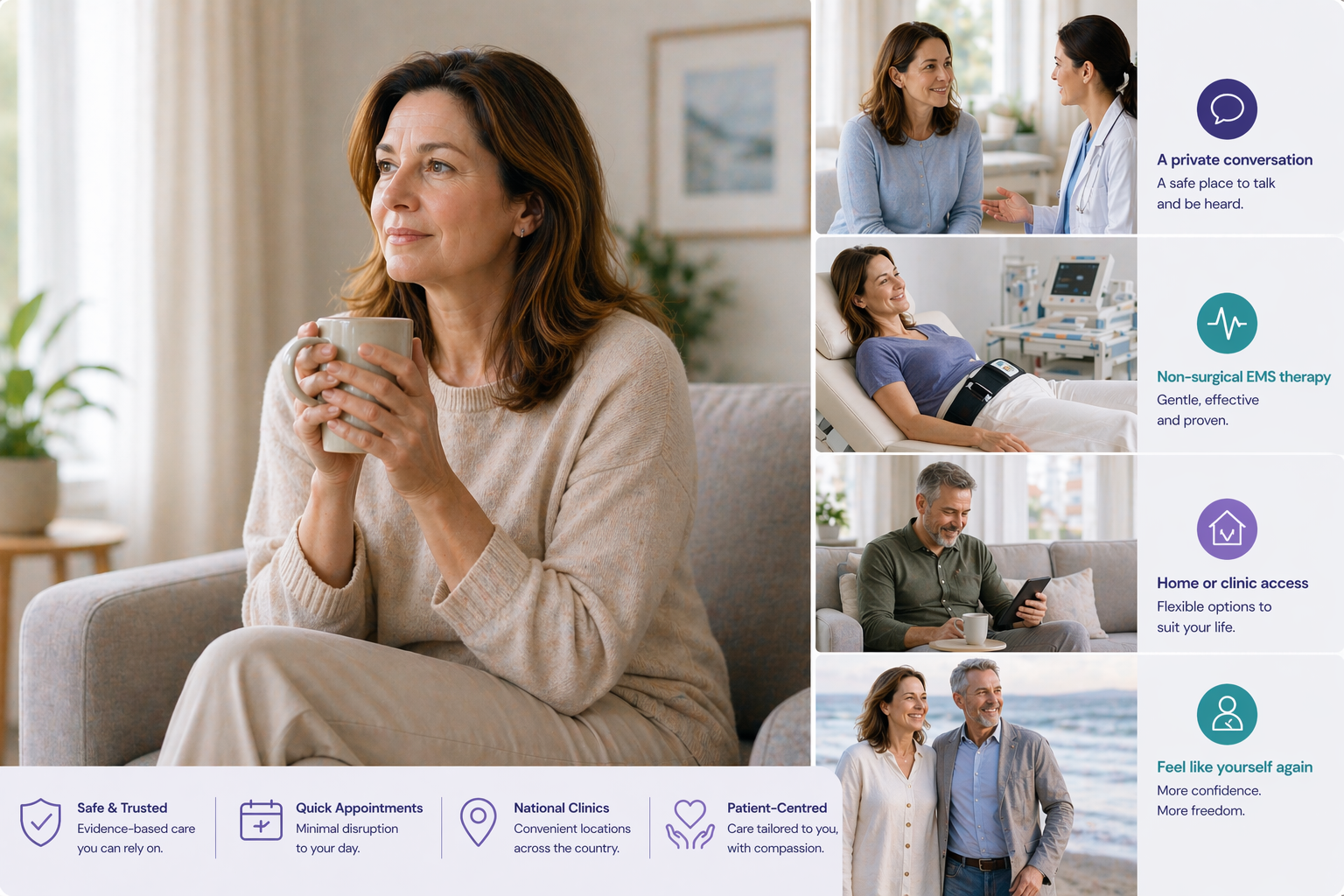
Incontinence Direct offers non-surgical support for both women and men, with EMS therapy, home access and national clinics. The experience is designed to be safe, patient-centred and genuinely considerate of the sensitivity of the issues involved.
These details matter. But they support something larger: hope. Not exaggerated hope. Just real hope. The kind that comes from realising there is very likely a better path ahead than the one you have been quietly managing by yourself.
That is the feeling this service should leave with anyone who comes across it. Not pushed. Not overwhelmed. Simply reminded — clearly, warmly and honestly — that help exists, that it is private, and that it can fit into a real life.
If incontinence is affecting daily life, self-image or general wellbeing, the conversation does not have to be difficult. There are gentler paths. There are easier ways to begin. And there are routes toward care that have been built with real thought, real sensitivity, and a genuine commitment to helping people feel more at ease — more dignified, and more in control of their own day-to-day life — once again.