
Incontinence Direct
Private, Non-Surgical Care
Discreet Support for Sensitive Health Concerns
There are health issues that are genuinely hard to discuss. This page describes, in plain language, the full range of support available — who it is for, how it works, and why a non-surgical, private approach makes such a meaningful difference.

There are certain health issues that are genuinely difficult to raise with others. Issues like incontinence, bladder leaks, bowel control concerns or erectile dysfunction can profoundly affect a person's sense of self and most people who begin making adjustments to their routines do so very quietly indeed.
They avoid long journeys. They plan every outing around available bathrooms. They hold back from exercising, travelling, making social arrangements or maintaining intimacy because they are always thinking about what might happen next. Over time, that private anxiety can become just as exhausting as the physical discomfort itself.
Which is exactly why Incontinence Direct was created. Designed for men and women seeking a more practical way forward, this service revolves around calm, quiet, non-surgical support, including Incontinence Direct Urge Incontinence Treatment. It is focused on EMS electromagnetic seating treatment a non-invasive therapy that strengthens pelvic floor muscles. It offers consultation-led care and tailored treatment planning, carried out in a way that is painless, requires no undressing, and involves no downtime whatsoever.
For many, the hardest part is not the treatment itself. It is the decision to begin. At best, a person may have spent months or years managing quietly in silence, believing their symptoms will eventually resolve on their own. This service is designed to feel like a steady, reassuring first step not dramatic, not intimidating, but clear and kind and easy to read.
The core non-surgical therapy that underpins every service offered.
Specifically designed to address the different needs of men and women.
No undressing required. No clinical exposure. Entirely discreet throughout.
Home-based treatment available for those who prefer it.
Return to everyday activity immediately after every session.
Every treatment plan is built around the individual, not a generic template.

When someone has incontinence or another related intimate health condition, they are rarely focused only on the symptom itself. They are already working out how to explain it if necessary, how much of a distraction it is likely to become, whether others around them might notice, and whether something can be done without a sweeping structural change to their life.
Which is precisely why privacy matters so much in a service like this. Incontinence Direct is consistently positioned as a discreet, non-surgical provider for both men and women suffering from sensitive symptoms, including Incontinence Direct ED Treatment Without Surgery. There is no surgery required, no medication, and no annoying downtime the treatment is comfortable and convenient, designed specifically to help people take control once again.
That combination resonates with what most people genuinely desire. They do not want to feel rushed. They do not want to be judged. They do not want to be subjected to something that feels cold or unnecessarily clinical. They need help that seems respectful and practical something that fits into real life without demanding a dramatic change of direction.
Electromagnetic seating treatment commonly referred to as EMS is the main therapy provided across the service. It is a non-invasive treatment suitable for those experiencing pelvic floor weakness. It works by using high-intensity electromagnetic technology to help strengthen muscle, improve bladder control, and address a range of related symptoms. The treatment is marketed as entirely comfortable no surgery, no needles, no drugs, and no recovery time of any kind.
Pelvic floor strength is important because a significant number of problems stem from weakness in that foundational area. This can manifest as urinary incontinence, stress incontinence, Incontinence Direct Overactive Bladder Treatment, mixed incontinence, faecal incontinence or problems of intimate health including erectile dysfunction. Rather than treating each of those concerns as entirely separate annoyances with no apparent connection, EMS therapy concentrates on strengthening the muscles that underpin control and function across all of them.
The treatment itself is depicted as uncomplicated and straightforward. Patients remain fully clothed and sit comfortably in a chair, allowing the electromagnetic pulses to work through the session. Sensations during treatment are typically described as tingling and contractions in the pelvic floor confirming that the muscles are responding with no pain and no discomfort of any significance.
According to the service, patients typically require approximately six to eight sessions. Some individuals choose maintenance sessions following their initial course to keep the pelvic floor muscles strong and to sustain continued benefit over time. Every plan is confirmed with a specialist who tailors the approach to the individual.
Part of what makes EMS treatment so accessible is its simplicity. It does not demand that people upend their lives. It provides treatment that can be plugged directly into an existing schedule. It does not involve a major recuperation phase, and it does not place anyone in a situation that feels overwhelming or frightening.
It offers a sensible, manageable approach to rebuilding strength and control — one step at a time. For many of the people who come to this service, it is precisely that simplicity that makes the journey feel genuinely achievable. Not a grand undertaking. A steady, private, dignified process.
Good pelvic floor strength underpins management and function across a wide range of symptoms. EMS addresses the source directly — strengthening the foundation — rather than simply managing what appears on the surface.
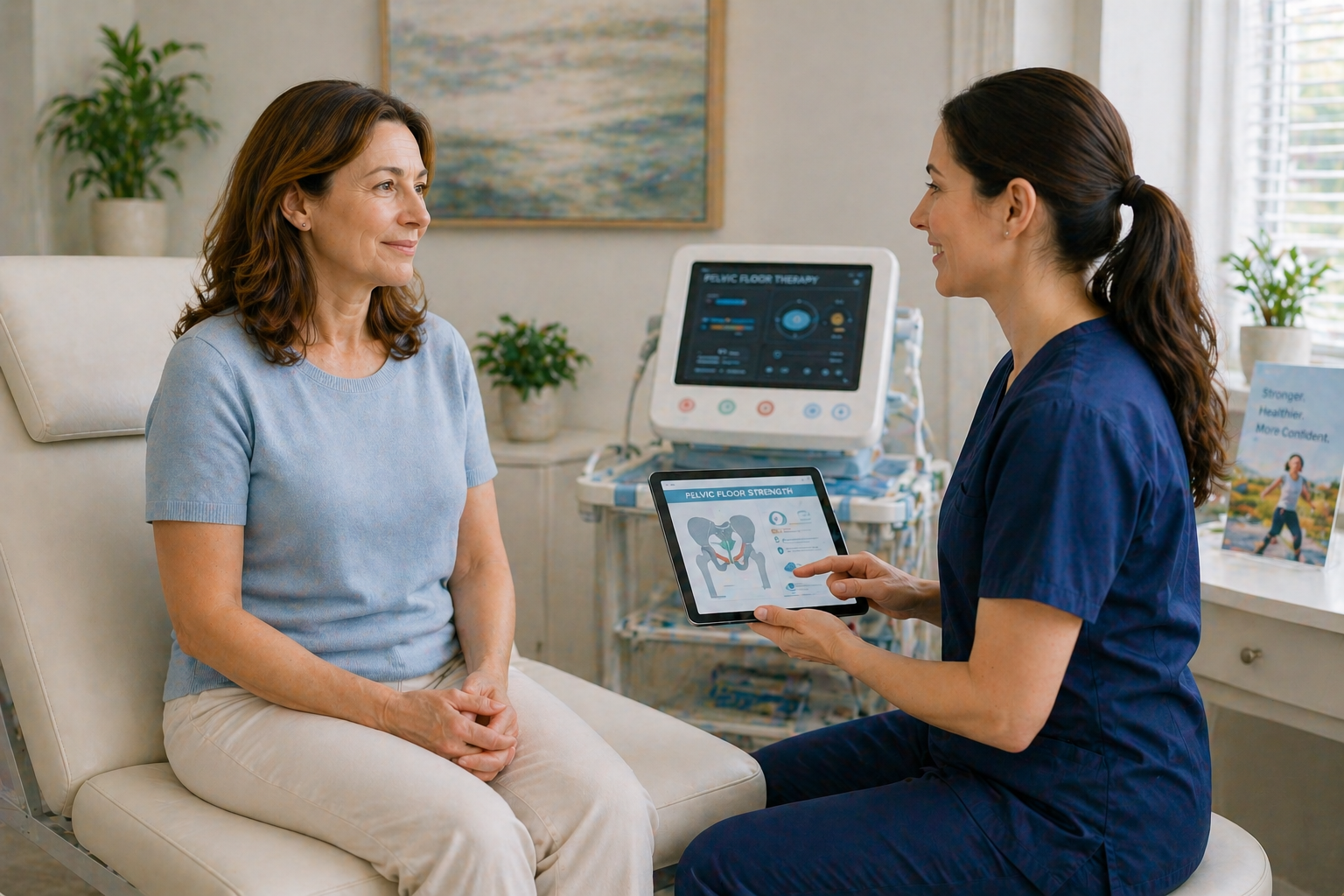
Incontinence and related symptoms are genuinely draining — even when they appear minor at first. A leak here. A sudden urge there. More bathroom trips than usual. A small but embarrassing moment after a cough or sneeze. A growing sense that the body is becoming less predictable. Day by day, the pattern accumulates, and before long it begins to shape the course of the day in ways that feel inescapable.
Everyone knows where the nearest bathroom is. They begin choosing darker clothing. They carry extra items just in case. They plan travel differently. Exercise, once enjoyable, gets quietly set aside. They may decline social invitations — worn down by the constant low-level uncertainty. A kind of adaptation becomes so normal that the person almost forgets the cost at which it has been achieved.
These symptoms can be more than a nuisance. They affect confidence, comfort and quality of life in ways that are difficult to put into words. These are real effects on real people — and they all deserve to be taken seriously.
Generally speaking, the people who come to this service do not need to be persuaded that the problem is significant. They already know that. What they need is to know that someone else understands it too, that the support available is private, and that meaningful help does not have to involve surgery or a major upheaval.
That is what these services aim to be capable of offering. Each treatment area is grounded in the same calm, respectful approach — honest about the challenge, practical in its response, and always designed around the person rather than the condition.
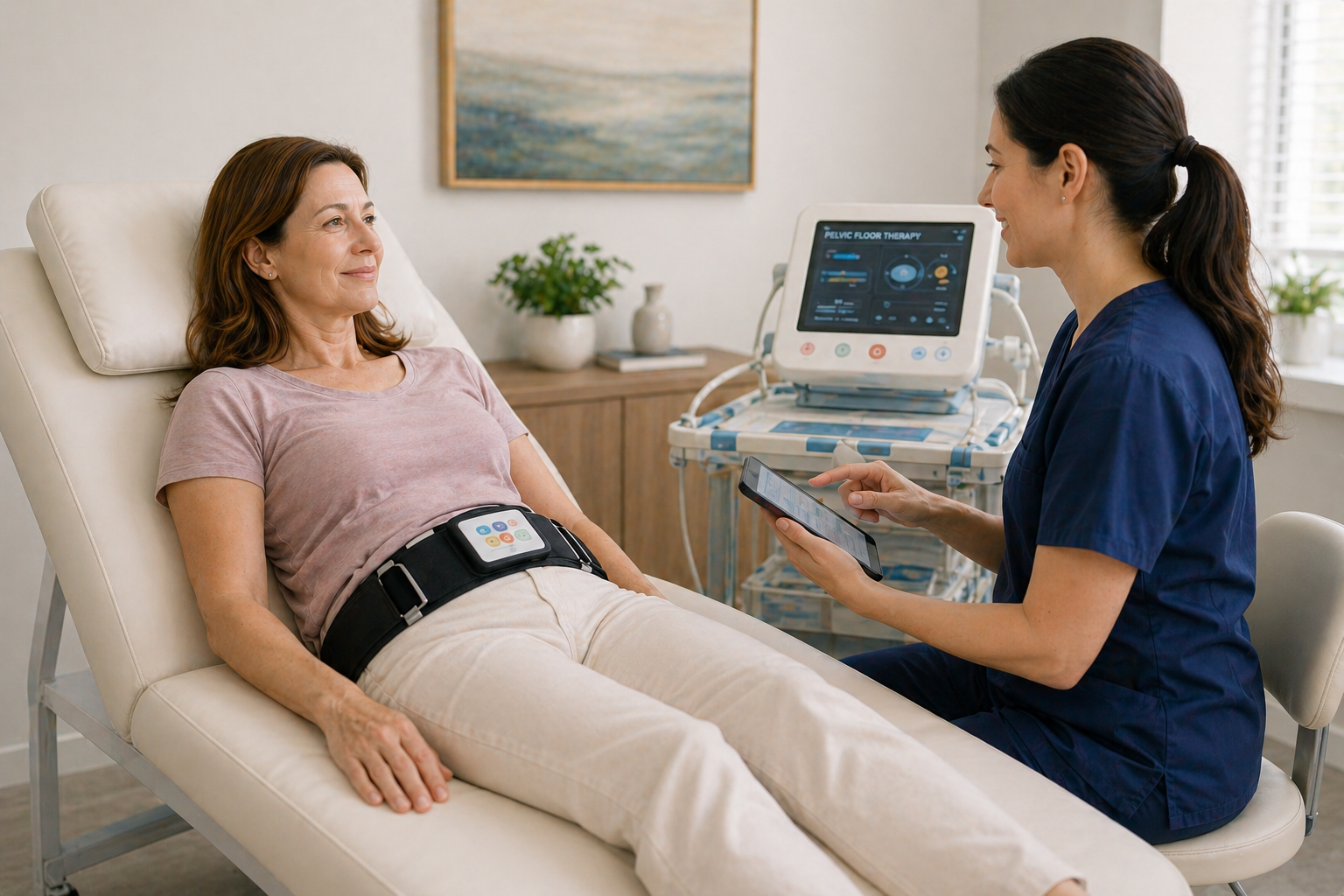
Urinary incontinence can present in more than one way, and the experience can be markedly different for both men and women. For some, it manifests as leaking during physical activity — coughing, sneezing, laughing, exercising or lifting. For others, it involves urgency symptoms: a sudden compelling need to reach a bathroom that is difficult to suppress and that can result in leakage before getting there. Others will find themselves experiencing a combination of both patterns rather than one single type.
The urinary incontinence service offered here is centred on non-surgical EMS technology. The treatment works by strengthening pelvic floor muscles and improving bladder control, reducing leaks and enhancing intimate wellness — all while the patient remains fully clothed throughout. The treatment is intended for those who lose urine during everyday activities or experience urgency symptoms. It is particularly well-suited to men following prostate surgery, women post-childbirth, women in menopause, and others seeking non-surgical strengthening of the pelvic muscles.
That is a broad but entirely reasonable group — because urinary symptoms can emerge for very different reasons. Some people notice changes after childbirth. Others find symptoms appearing after surgery or with age. Some simply feel that their pelvic floor has gradually lost strength somewhere along the way. Whatever the reason, the practical need is largely the same: tighter regulation, less leakage, and a greater sense of assurance in everyday life.
What makes this treatment so accessible is not the technology alone, but the context surrounding it. It is comfortable, fully clothed and requires no downtime. A person can complete a session and continue with the rest of their day entirely as normal. For someone who has never sought help because they were afraid of disruption, that can represent a genuine and important turning point.
Stress incontinence is arguably the most disruptive type of bladder leakage — because it strikes during entirely ordinary activity. A cough. A laugh. A sneeze. A run. A lifted shopping bag. A workout. These moments are not unusual or avoidable. And that is precisely what makes this symptom feel so relentless — it can appear almost without warning during the most routine parts of the day.
People often begin adapting long before they seek treatment. They may stop jumping, running or exercising in the way they used to. They may change how they dress. They can become anxious in public settings because they never know which small movement might result in a leak. That kind of quiet tension can build gradually over time — and silently diminish quality of life in ways that are hard to articulate to others.
The service offers EMS technology as the answer — working directly on strengthening the pelvic floor and improving control of these leaks. It is non-surgical, non-invasive and designed to deliver longer-lasting results through a course of targeted sessions. Some people choose to follow their initial course with maintenance sessions to sustain the improvement.
Why this matters goes beyond symptom management. Stress incontinence affects confidence in a tangible and personal way. Someone who feels comfortable in their own body will generally move with greater freedom, exercise with more ease, and live each day with greater enjoyment. Someone who is perpetually anticipating the possibility of a leak begins to withdraw — in small but deeply significant ways.
Effective treatment does not simply reduce a symptom. It gives back a degree of that freedom — quietly, practically, and without any need for surgery or disruption. That return to confidence is often far more meaningful than the physical improvement alone.

Mixed incontinence presents a particular kind of challenge — because more than one type of symptom is present at the same time. A person might experience leakage with physical movement alongside sudden urgency and difficulty reaching a bathroom in time. That combination can make day-to-day living considerably more disruptive than a single symptom type alone.
Mixed incontinence is defined as the presence of both stress and urgency symptoms simultaneously. EMS is presented as a modern, non-surgical treatment alternative — and a good option for many patients who want to address both symptom types without resorting to surgery or medication. For some patients, symptoms can be significantly reduced; for others, they may resolve more fully with a consistent course of treatment.
That kind of flexibility matters greatly. Mixed symptoms are often more disruptive than people expect, because they change both the timing and the circumstances under which leakage or urgency might occur. Someone might feel uneasy during a workout but also feel anxious when stuck in traffic, leaving the house, or simply sleeping through the night. Their bladder and its needs are always present — always needing to be planned for.
A service addressing mixed incontinence should recognise that experience with care. It should make clear that mixed symptoms are a valid, widely recognised clinical reality — not an obscure or untreatable combination of difficulties. And it should offer reassurance that a personalised response is entirely possible.
EMS treatment is particularly well suited to mixed incontinence because it targets the pelvic floor directly — the underlying mechanism that influences both types of symptom. Rather than treating the discomfort that appears on the surface, it addresses the muscles working behind the scenes. That is precisely the kind of practical, foundational support that many people dealing with mixed symptoms have been looking for.
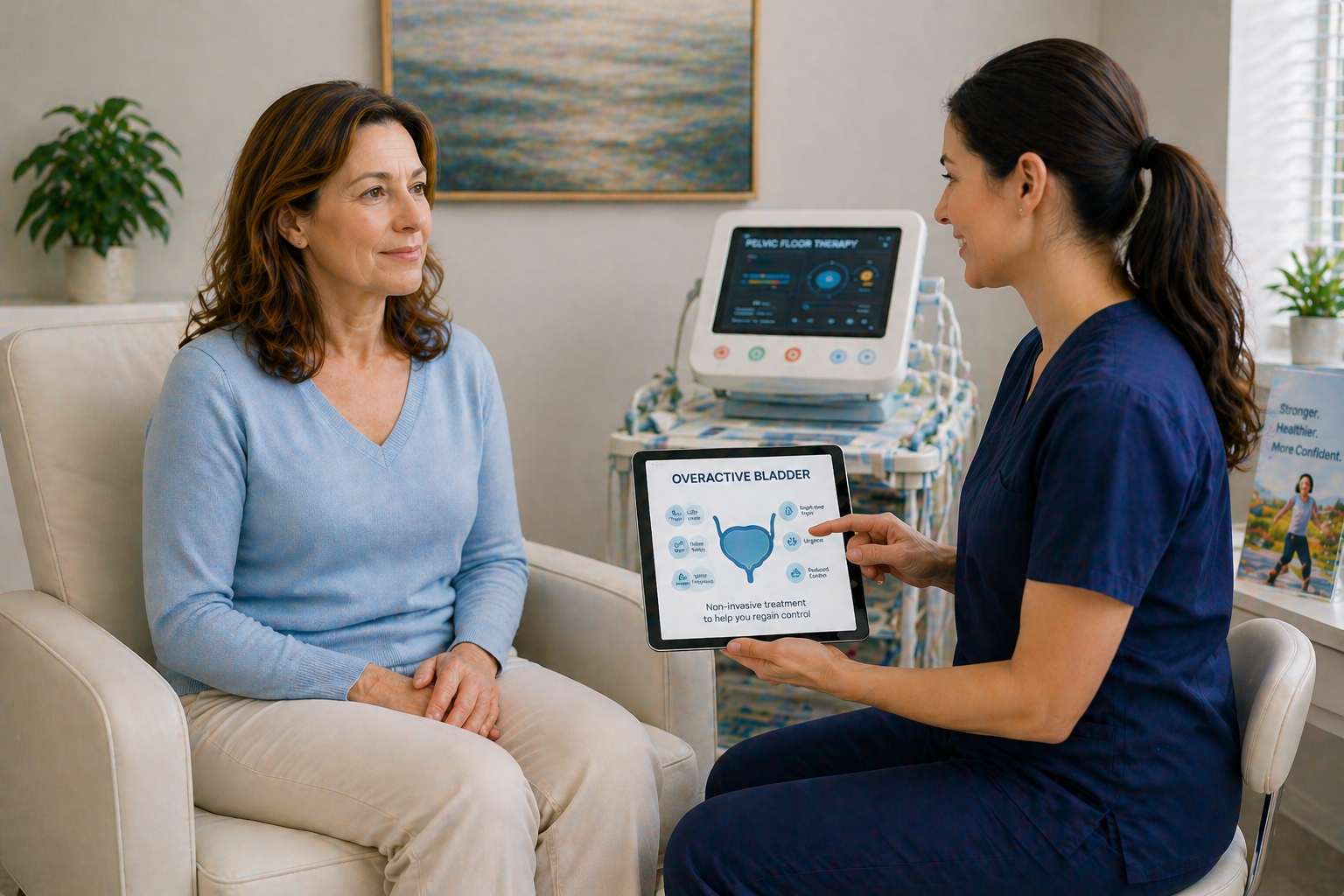
If someone has never lived with an overactive bladder, it can be genuinely difficult to explain. It may sound like simply needing to go to the bathroom frequently — but in practice, it is considerably more than that. It is the urgency. The immediate, urgent need to stop whatever is being done. The anxiety about whether a toilet is near enough. The interrupted sleep. The underlying sensation of the bladder dictating the schedule rather than the person who is supposed to be in charge of it.
EMS treatment is offered as a newer, non-invasive approach that aims to help people regain control of the bladder and reinforce the pelvic floor muscles — minimising urgent urination, reducing hyperactivity and decreasing or eliminating leaks. The treatment is presented as operating without surgery, drugs or any time out from daily activity. It fits directly into life rather than asking anything of it.
This is important because it places practical, actionable solutions in front of the very real problem that most people with an overactive bladder already know all too well. They have often tried drinking less, planning more carefully or trying to simply ignore the problem altogether. Most people already know those strategies are at best temporary — they tighten the pressure on the person rather than addressing the root of it.
The connection between pelvic floor strength and broader wellbeing is also worth noting here. Strengthening the pelvic floor may support not only stress and urge incontinence, but also aspects of sexual function in some cases. That broader picture is important — because bladder control does not exist in isolation. It takes a toll on confidence, mobility, sleep quality and day-to-day comfort in ways that are interconnected and deeply personal.
Overactive bladder is not a character defect. There is nothing shameful about it. It is a legitimate health concern that deserves real, considered, practical attention. The tone of care around this should always reflect that — steady, clear, and entirely free of judgement.

Stool incontinence is one of the most intimate and difficult challenges a person can carry. For many individuals, the emotional weight of bowel control concerns far exceeds the physical symptom itself — and it can make the subject particularly difficult to raise, even in a healthcare environment that is explicitly designed to be helpful and non-judgemental.
This part of the service needs to be approached with particular care and gentleness. EMS chair therapy is offered as a newer non-surgical method that restores bowel control, strengthens pelvic floor contractions, and reduces the frequency of episodes — with low risk and no downtime. The service's message here is simple, clear and deeply respectful: no one should allow stool incontinence to prevent them from leading life with the dignity and comfort they deserve.
That is the right message. And the tone of care around it must be equally right — because the people who come seeking help with this particular symptom have often carried it silently and alone for a very long time. When you are constantly aware of the possibility of something happening, every part of daily life can feel affected. Work. Travel. Social confidence. Intimacy. Running simple errands. The emotional burden can be immense — and it rarely gets easier with time.
The treatment description here should be written with warmth and quiet confidence. The problem is real. There are ways to seek help. The support available does not have to be intrusive or expose the person to further discomfort or shame. Its non-surgical and discreet premise aims to enhance muscle tone and pelvic control — creating the foundation for a life lived with less restriction.
Those affected by stool incontinence typically want one thing above everything else: to feel normal again. To move through life without that particular weight. This service should appeal directly to that desire — quietly, honestly, and with real respect for what has already been endured.
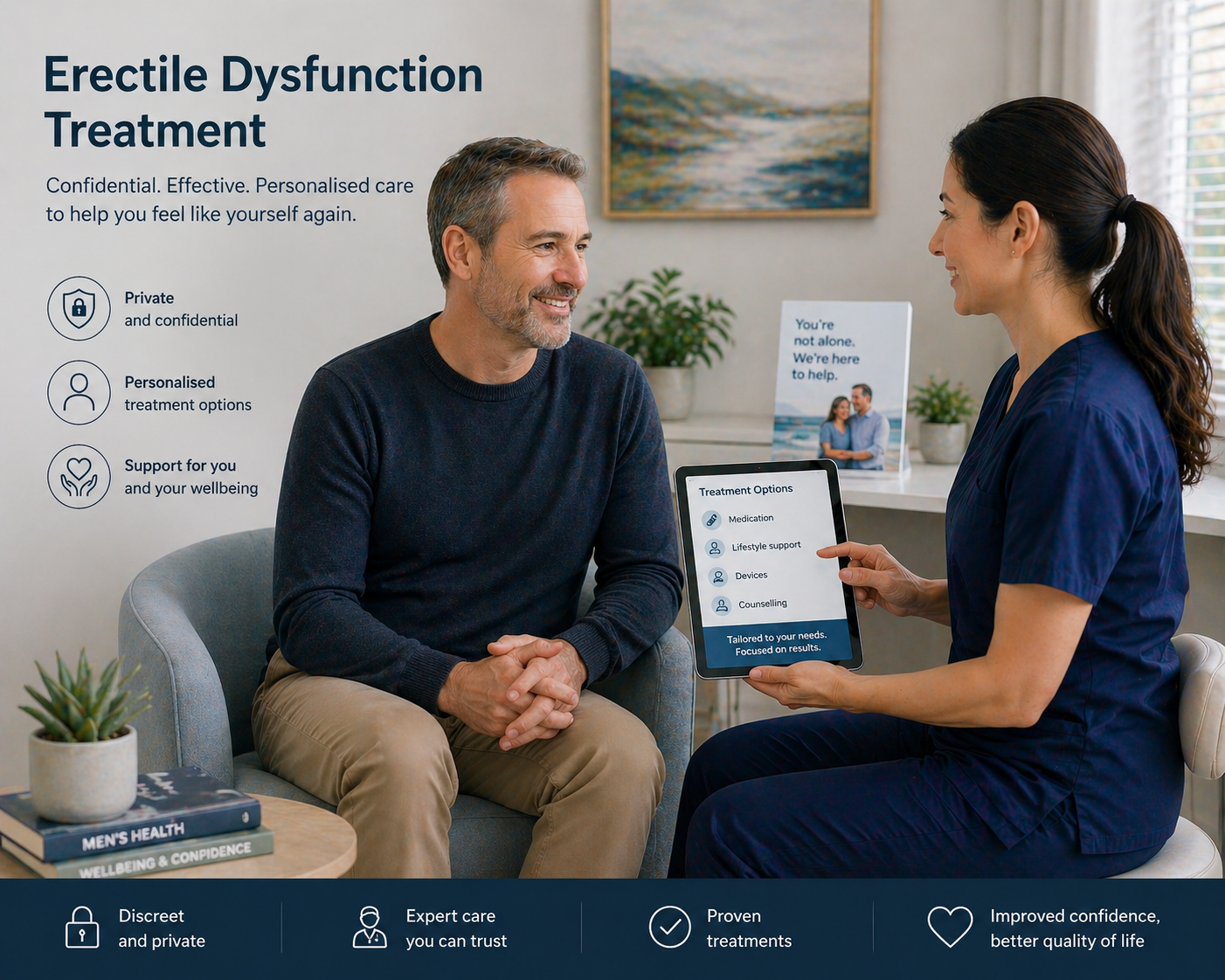
Erectile dysfunction is another deeply personal subject that many men find genuinely difficult to discuss. The emotional consequences can be as significant as the physical symptoms — capable of affecting self-confidence, intimacy and the quality of close relationships in lasting ways. Too many men carry that weight quietly, with the very real fear of feeling exposed or alone in the experience.
The erectile dysfunction service is described as a means of reclaiming confidence and renewing intimacy. EMS is positioned as a non-invasive solution — treatment that is carried out fully clothed, involves no needles or drugs, and is designed to help strengthen deep pelvic floor muscles, increase blood flow and improve erectile function. Sessions are fast and described as painless, lasting approximately thirty minutes, with no downtime afterward.
Erectile dysfunction can be linked to weakened pelvic floor muscles. EMS stimulates deep muscle contractions in a way that mirrors an intense but entirely comfortable workout for the pelvic floor. The treatment is suited to men facing erectile dysfunction connected to compromised pelvic floor muscles, and a consultation is used to confirm whether it is the appropriate path forward for each individual.
What many men need is something simple and genuinely practical. They need to feel that they are not being judged. They do not want to be directed toward a treatment that feels unnatural or more complicated than what they anticipated. They want an option that is discreet, respectful and easy to engage with. They need to feel that a straightforward conversation about the problem is actually possible — one they can have without embarrassment, in their own time, at their own pace.
Erectile dysfunction is common. It is treatable. And there are non-surgical choices available that will not upset the everyday flow of life. That is a message that deserves to be communicated clearly, warmly and without any of the awkwardness that so often surrounds this particular subject.
The service is targeted towards men and women dealing with intimate health issues — the kinds of concerns that most people are reluctant to discuss openly, even with close friends or healthcare providers. It covers a genuinely wide range of people and circumstances.
This includes people experiencing post-childbirth urinary leakage, age-related pelvic floor weakening, side effects from medication, post-prostate surgery symptoms, overactive bladder, mixed symptom presentations, constipation or bowel control concerns, and erectile dysfunction. It may also include people who simply feel that their pelvic floor is less robust than it once was and want to take proactive action before symptoms become more disruptive.
Changes to pelvic floor strength following childbirth are extremely common. Treatment offers a practical, non-surgical path toward rebuilding strength and regaining confidence in everyday movement.
Following prostate surgery, urinary incontinence is a common and distressing side effect. EMS treatment specifically addresses the pelvic floor weakness that underlies these symptoms.
Age-related weakening of the pelvic floor affects both men and women. Treatment offers a dignified, discreet and manageable path toward improved control — regardless of age or fitness level.
For those who feel the bladder dictates the schedule rather than the other way around, EMS provides a non-surgical and non-invasive path toward improved management and daily confidence.
Bowel control issues affect quality of life in profound and often unspoken ways. A discreet, effective and respectful treatment option is available — without the need for surgery or medication.
Not everyone who comes to the service has severe symptoms. Some people simply want to act early — maintaining pelvic strength before symptoms become disruptive. That is entirely valid and actively encouraged.
The straightforward message is this: if bladder control, bowel control, pelvic floor weakness or intimate function is the issue, there is likely a practical option outside of surgery worth considering. The service is broad enough to accommodate many different presentations — and specific enough to take each individual situation seriously.
Most people do not want to go straight to surgery. This is not because they are afraid of receiving help. It is because they are looking for a way to alleviate symptoms with less interference and in a gentler manner — practical first, before any invasive measures are considered. They want a solution that accommodates work, family and life as it actually is. They may not want to deal with recovery time, controlled medication or the anxiety that can accompany more extensive procedures.
Throughout this service, EMS treatment is consistently referred to as a non-surgical solution. Non-invasive, fully clothed and with no downtime — those three qualities matter. Many of the service pages also make clear that for those looking to tone and rebuild pelvic muscles, it can be an effective, non-surgical and drug-free alternative that holds its own in terms of results.
That framing matters because it changes the way people think about their choices. Non-surgical care should never be presented as a lesser or second-choice option. It should be portrayed as a sensible, modern alternative for those who want effective support with fewer interruptions. It is a choice made from a position of knowledge, not avoidance.
And that is the difference between reading about the service and being motivated to act. When treatment feels private, manageable and non-disruptive, it feels genuinely achievable — something that can happen now, rather than something to be deferred indefinitely.
Many people have been postponing help for a significant period. They tell themselves things will improve on their own. Some wait to avoid looking foolish or unnecessary. Some feel their symptoms have not yet reached a threshold that justifies the effort. Others have simply adapted so completely that the issue has become integrated into life whether or not they consciously chose it to be.
For all of those people, the right message is the same. Waiting is a natural response. But it is no longer something that needs to continue. Help is available now, here, in a form that is designed around comfort and convenience. That message — calm, clear and practical — is often all that is needed to shift from hesitation into action.
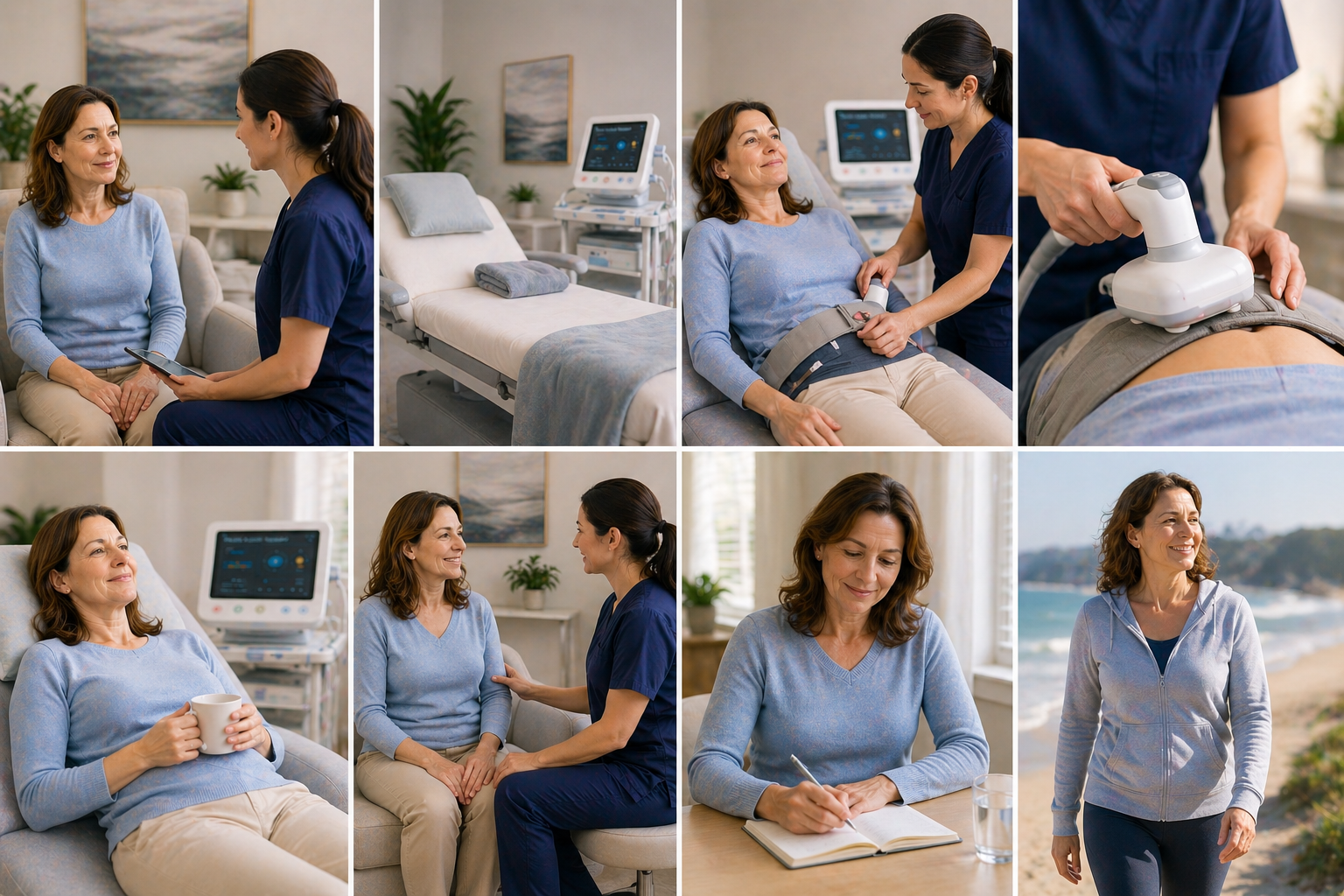
The first thing most people want to understand is what the treatment actually involves. That is entirely natural, and this service answers it clearly. Patients are fully clothed and sit comfortably throughout each EMS session. The procedure itself is pain-free. Most people feel tingling and mild contractions in the pelvic floor during the treatment — sensations that confirm the electromagnetic technology is engaging the muscles as intended. The great majority of patients are able to return to their daily routine immediately after each session ends.
That kind of detail is genuinely comforting because it removes uncertainty. So much hesitation comes not from genuine fear of treatment, but from simply not knowing what to expect. People may imagine something too embarrassing, too awkward or too physically demanding to manage. In reality, the treatment is quiet and serene. The chair does the work. The patient simply sits and allows the session to proceed.
Treatment plans typically recommend around six to eight sessions in the first instance. Some conditions have slightly different protocols — the erectile dysfunction course, for example, often involves six sessions over a three-week period, confirmed with a specialist. For all conditions, the plan is flexible, because no two people share identical treatment schedules or needs.
Tracking progress is one of the most valuable things a service can do for its patients. Not every improvement is dramatic or immediate. Sometimes change begins with a little less urgency. A little more confidence. Less planning required before leaving the house. More authority in exercise or when travelling. A better night's sleep. A lighter mental load. Those smaller changes matter enormously.
People may notice improvements after several sessions, and results may continue to develop after completing the full course. Some people choose maintenance sessions to keep pelvic floor muscles strong and to sustain continued benefit. That is not a sign of failure — it is a sign of good, thoughtful self-care. Progress in healthcare rarely happens overnight. A gradual build is how meaningful and lasting change is achieved.
No two patients present with identical symptoms, identical goals or identical comfort levels. That variability is not a complication — it is precisely why the consultation is so central to this service. Treatment begins with an initial consultation that explores symptoms, medical history and objectives, in order to build a personalised treatment approach. Suitability is assessed individually, and the provider confirms the most appropriate path forward for each person before anything else begins.
That is both good practice and good communication. A consultation gives people the space to articulate what they are actually going through — rather than trying to squeeze their experience into a pre-existing definition. One person may be worried about leaks during exercise. Another may be dealing almost entirely with nocturnal urgency. One may need support after giving birth. Another may want to talk privately about bowel control or erectile function.
A tailored plan allows the service to respond to the individual rather than a generic category. That is what makes good care feel genuinely thoughtful rather than transactional — and it builds the kind of trust that makes people more likely to engage fully and stick with the process.
When people feel that a treatment plan has been shaped around them specifically — rather than handed to them from an off-the-shelf list — they engage more willingly. They feel respected. They feel listened to. Their challenge is being treated as if someone applied real thought to it. That level of trust is what a good service should inspire before a person has even spoken to anyone.

Real life is busy. Juggling work and family commitments means that some people are never fully present in either space. That makes it genuinely difficult to commit to a course of treatment that adds further pressure to an already stretched schedule — even when the expected rewards are clearly worth pursuing.
Which is precisely why convenience makes such a fundamental difference in a service like this. Treatment is presented as quick, painless and involving no downtime whatsoever. Home-based care is part of the broader offering across numerous conditions. Taken together, that creates a service that works for people who want privacy and flexibility in equal measure — and for whom treatment cannot be allowed to interrupt their day in any significant way.
It is easy to underestimate what convenience actually means in healthcare. But in practice, it is often the single factor that transforms something from aspirational into genuinely accessible. The difference between struggling through symptoms alone and actually seeking help can sometimes come down entirely to whether the process feels manageable enough within the constraints of a normal week.
For someone who has been postponing help for months because of travel constraints, time pressures, or the embarrassment of being seen in certain environments, a service that offers home visits and short sessions is not a luxury. It is the difference between continuing to cope alone and finally beginning to move forward.
There is a reason this service is consistently described as practical and effective. It does not ask people to change more than is truly necessary. It does not require lengthy recovery. It does not demand a reorganisation of weekly life. It simply provides a more open avenue toward care — one that has been thoughtfully designed around the real pressures and priorities of people who already have plenty to manage.
That is a fundamentally kind design philosophy. And it makes help more accessible to exactly the people who need it most — the people who would most like to seek support but have been stopped by practicality, embarrassment or the sheer weight of their current commitments.
Tone is more than ornamentation in writing. It shapes trust. For topics as personal as pelvic health, bowel control or sexual function, the tone tells readers whether the service genuinely understands the emotional reality of what they are reading. When language is too clinical, it sounds distant. When it is too promotional, it creates pressure. When it sounds like a diagnosis, it pushes people away.
The most effective tone here is human, calm and respectful. Copy that sounds like a conversation with someone who understands privacy and sensitivity. Businesslike without being stiff. Warm enough to feel welcoming without being inappropriately familiar. Clear and direct without making the reader feel pressured into anything.
This approach is already embedded in the service's positioning. Discreet care, patient confidence and non-surgical support for both men and women. Relief, control and quality of life — not merely symptom management. That is the right conceptual foundation for everything that follows.
People should feel, as they read through this service, that it was built for real human beings dealing with real issues. Not a generic healthcare template assembled from standard language. Not a pushy sales page. A thoughtful, methodical and deeply human response to a genuinely difficult set of questions.
"When the language is kind but direct, people pay attention. When the message sounds authentic, they begin to trust the process. That is what creates the confidence to reach out."
And that is the entire purpose of this page — not to overwhelm, not to impress, but to provide steady and honest clarity about what is available, how it works, and why it might genuinely help someone who has been carrying something difficult alone for far longer than they should have.
Health issues that impact control, confidence and daily comfort are about as personal as it gets for a human being. But these problems are not meant to be suppressed forever, managed in silence, or accepted as permanent features of daily life that cannot be changed.
Whatever the symptom — urinary leakage, stress incontinence, mixed incontinence, overactive bladder, stool incontinence or erectile dysfunction — this service offers one simple, clear message: there is help available. It can be discreet. It does not have to involve surgery or a major lifestyle change. Incontinence Direct Electromagnetic Seat Therapy is non-invasive, fully clothed, and requires no downtime. It can be customised following consultation, and it is appropriate for both men and women dealing with a wide range of symptoms.
That is what makes this service genuinely different. It is not pretending the problem is worse than it is. It is not minimising it either. It is simply giving it the serious, decent and practical treatment it deserves — in a setting that respects the individual at every single step.
A great many people wait too long before seeking support. They believe the problem will improve on its own. They feel their symptoms are not severe enough to justify asking for help. They have adapted so thoroughly that seeking treatment now feels like admitting something they would rather not acknowledge. None of those reasons are invalid — but none of them are reasons to continue waiting, either.
The service pages here have been designed to address that hesitation directly. They show that treatment can be gentle, conducted in normal clothing, fast and guided by professionals who take the problem seriously. They show that the service is designed for a wide range of conditions across bladder, bowel and sexual health — all of them real, all of them recognised, and all of them worthy of a thoughtful response.
They just need a place to start. A first step that does not feel overwhelming. A service that sounds steady, experienced and genuinely human in its approach. That is what every part of this service has been built to provide — from the first line of an initial enquiry to the final session of a personalised treatment course.
And that is so often exactly what people need most of all. Not a grand solution. Not a miracle claim. Just real, private, practical support — delivered with care, delivered with discretion, and delivered entirely on the individual's own terms.